01Intake
Forward the report.
Send the vulnerability email to triage@agent.casco.com. It lands in the real Casco triage inbox.
Report receivedAn agent for your vulnerability inbox
Forward the inbox. Casco finds the context, tests the claim, and interrupts your team only when it is real.
triage@agent.casco.comSENT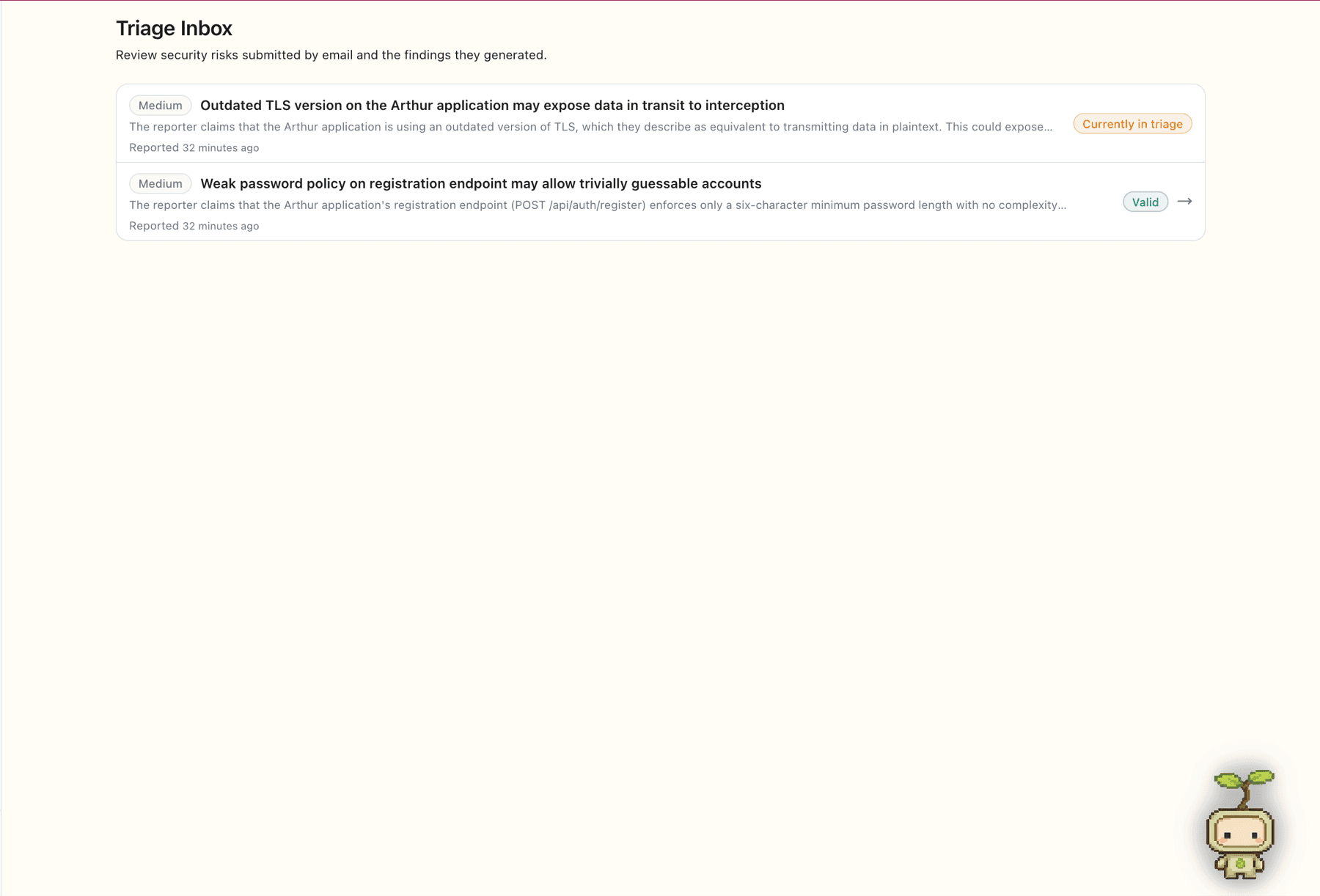
The forwarded report appears in Casco, ready for investigation.













From report to verified verdict
Report received
CAPTURED IN CASCO / JULY 27, 2026Send the vulnerability email to triage@agent.casco.com. It lands in the real Casco triage inbox.
Report receivedSend the vulnerability email to triage@agent.casco.com. It lands in the real Casco triage inbox.
Report receivedCasco turns the emailed claim into a finding and attaches the application context it used.
Finding openedRead the real reproduction, code, and output that Casco used to test the claim.
Evidence capturedThe conclusion stays attached to the original finding, including why the claim is or is not exploitable.
Investigation completeBetween inbox and verdict
Security engineers lose time rebuilding context, reproducing the claim safely, and writing the handoff. Email Triage absorbs that middle.
Hunt for the affected app, tenant, and identity.
Context arrives attached.Reproduce the claim without crossing scope.
The test runs inside your rules.Turn raw requests into a defensible verdict.
Proof and reasoning arrive together.The outcome
Every report gets investigated. Your team only gets pulled in when Casco can show what is real, where it matters, and how it was reproduced.
Invalid, duplicate, or irrelevant reports are closed with the investigation attached.
The affected application, reproduction, evidence, and impact stay together.
The original test and conclusion remain available when the team is ready to verify the fix.
You control the test
Choose the assets, environment, and test identity before the agent runs.
Keep the request chain, evidence, and verdict attached to the original report.
Define the decisions that require approval before anything consequential happens.
Email Triage FAQ
Direct answers about vulnerability intake, autonomous validation, safety, and the role of human review.
Vulnerability report triage is the process of reviewing an inbound security claim, separating it into testable issues, gathering missing application context, reproducing the reported behavior, assessing impact, and deciding whether to escalate or close it.
Forward vulnerability reports to triage@agent.casco.com. Casco separates each report into testable claims, maps them to the relevant application and business context, validates them within your defined scope, and returns either an evidence-backed finding or a documented reason for closing the claim.
Send or forward vulnerability reports to triage@agent.casco.com. The email can include researcher submissions, scanner output, customer-reported issues, and attachments related to the claim.
Casco can investigate bug bounty and vulnerability disclosure submissions, customer-reported security issues, internal reports, and scanner-generated findings delivered by email. It is especially useful when a report needs validation against the real application context.
Casco does not rely on the reported severity alone. It resolves the target application, test identity, permissions, tenant boundary, and relevant business logic, then safely attempts to reproduce the claim. The verdict is based on observed behavior and demonstrated impact.
No. Casco removes repetitive first-pass investigation and gives the security team evidence, reproduction steps, and decision reasoning. Your team keeps control of scope, guardrails, escalation rules, and any required human review.
Casco closes unsupported or non-exploitable claims with the investigation reasoning preserved. Valid findings are escalated with evidence and reproduction steps, so engineers can focus on the issues that require action.
A scanner identifies patterns and an inbox rule routes messages. Casco investigates the claim in the context of your application, attempts a safe reproduction, and produces a decision with evidence. It is an investigation layer, not another source of unverified alerts.
Testing runs within the assets, environments, identities, exclusions, and escalation rules defined by your team. Human supervision can be required for sensitive or nuanced actions, and the investigation record remains visible.
Triage the inbox, not your calendar