How to Hack Ford.com for $130,000
Disclaimer: The vulnerability discussed in this post was responsibly disclosed to the Ford security team. The issue has been addressed and is no longer exploitable.
Sometimes the most critical flaws are simply operational oversights that no code analysis could ever catch. Casco discovered a vulnerability in Ford's infrastructure. A "dangling pointer" in their DNS could have allowed an attacker to fully compromise user accounts.
Here is how a forgotten subdomain and a $130,000 domain purchase could have led to a massive breach.
The Discovery: A Dangling Subdomain
While mapping the attack surface of ford.com, we identified a subdomain that looked interesting:
m.dominicana.ford.com
This subdomain was configured with a CNAME record pointing to an external service. Specifically, it was pointing to a domain managed by redirect.ford.icm.io.
When we visited the subdomain and saw a Godaddy domain offered up for purchase. This is the classic signature of a Subdomain Takeover.
In a standard takeover, an attacker simply registers the unclaimed resource at the third-party provider (like claiming an unused S3 bucket name) for free. But this case was different.
The $130,000 Paywall (well, technically, it’s $129,500)
The icm.io domain that m.dominicana.ford.com pointed to was available for purchase.
We reached out to a domain broker to see what it would take to acquire the target domain. The response was unexpected. The price tag to acquire the necessary icm.io domain was $129,500.
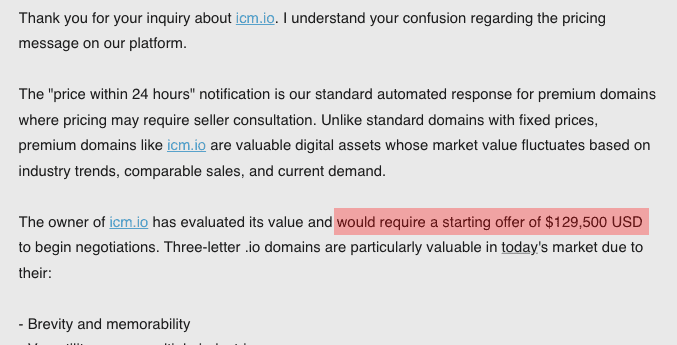
At first glance, this seems like a deterrent. Why would a hacker spend nearly $130,000 to perform a subdomain takeover? To understand the ROI for an attacker, we have to look at the potential impact.
The Chain of Impact: Broadly Scoped Cookies
We analyzed the authentication mechanisms on the main ford.com website. The cookies were set with the Domain attribute pointed to .ford.com. This is a common configuration that allows a user to stay logged in as they navigate between different subdomains (e.g., parts.ford.com or finance.ford.com).

However, this convenience feature becomes a critical vulnerability when a subdomain is compromised.
The Attack Path
If a sophisticated threat actor had purchased the icm.io domain, they would have gained full control over the content served at m.dominicana.ford.com. Here is what they could have done:
- Legitimacy Cloaking: The attacker hosts a phishing page at m.dominicana.ford.com. To the user, this looks 100% legitimate. It has a valid ford.com URL and likely a valid SSL certificate.
- Session Hijacking: Because the main application scopes cookies to .ford.com, when a logged-in user visits the attacker's controlled subdomain, the browser automatically sends the user's valid session cookies to the attacker's server.
- Credential Siphoning: The attacker's server logs these requests, harvesting active session tokens. They can now impersonate those users on the main Ford website, bypassing passwords and 2FA.
For a criminal organization, investing $130,000 to gain persistent access to Ford user accounts, potentially including financing info, vehicle controls, or personal data could be seen as a viable business expense.
Remediation
We promptly reported this issue to the Ford security team. They have since removed the dangling DNS record, effectively addressing the vulnerability.
Old infrastructure does not just disappear; it becomes a liability.
Disclosure Timeline
- [2026-01-05]: Vulnerability discovered by Casco.
- [2026-01-06]: Report submitted to Ford Security Team.
- [2026-01-07]: Dangling DNS record removed.
Casco is an autonomous security testing company. Our solution outperforms human-only pentesters by continuously monitoring your attack surface for issues before an attacker can exploit them.